Anita
A Man Called OveAnita is Rune’s wife and one of the earliest residents of the row-house street where Ove and Sonja make their home. Her life becomes increasingly organized around caring for Rune as he develops Alzheimer’s disease and loses daily abilities. When Social Services moves to place him in a care facility, Anita insists that love means remaining with him through difficulty. Her struggle turns private caregiving into a neighborhood concern and gives Ove a reason to act on a friendship he had long treated as settled history.
Identity and Early Relationships
Anita and Rune move onto the newly built street on the same day as Ove and Sonja. The area is then a quiet row of houses surrounded by trees. Anita is pregnant, as Sonja is, and the two women quickly become close friends. Their friendship precedes and helps prompt the men’s own connection: both women hope that their husbands will become friends because, in their view, they share interests. Ove remains unconvinced, especially because Rune drives a Volvo, but he gradually accepts Rune and eventually lends him tools.
The friendship between the two couples develops into practical cooperation. After Ove and Rune discuss lawn-mower prices, they shake hands with the air of men formalizing an agreement. Later, as new residents arrive, they meet in Ove and Sonja’s kitchen and establish rules, signs, and a steering group for the Residents’ Association. Ove becomes chairman and Rune vice chairman. Anita is not presented as a participant in the men’s formal leadership, but her friendship with Sonja is part of the social foundation from which the neighborhood’s connections grow.
Caregiving and a Changing Household
Anita’s difficulties come into view when she asks Ove for help with the radiators in her house. Rune, she explains, has been seriously ill and has Alzheimer’s; he is also in a wheelchair. Ove responds impatiently, but the request brings him face to face with the altered circumstances of a man who had once stood beside him in the parking area as a friend and neighbor. He eventually arrives at Anita’s door carrying an adjustable wrench and a small plastic watering can, and asks where the radiators are.
The narrative also identifies Anita’s own health challenges. Sonja had explained that Anita had undergone a hip replacement and that her shaking hands were associated with the first stage of multiple sclerosis. These conditions exist alongside her responsibility for Rune, rather than replacing it: Anita remains the person at home with him as his illness progresses. At one point she tells Ove that Rune has been sitting in his wheelchair, staring out of the window. Her account and his observation make the work of care visible in ordinary domestic space, without suggesting that she has ceased to regard Rune as her husband or that his presence has ceased to matter to her.
The Threat of Institutional Placement
The central conflict arises when Social Services tells Anita that Rune should go into a care home. She confides to Ove that the authorities believe she cannot manage his care. She is afraid that Rune will die if he is placed there, and Ove sees that her own health is compromised as well. Rather than answer her fear directly, he fingers a piece of corrugated iron and suggests that their son could help. The exchange shows both the limits of his first response and the pressure bearing on Anita: the proposed solution does not resolve her fear of losing Rune from their home.
The threat returns later with greater urgency. Parvaneh arrives at Ove’s door to say that Rune is going to be taken away, while Anita stands behind her. Anita explains that officials intend to collect him that week because they consider her unable to care for him. Her voice is fragile, and the news leaves Ove looking tired rather than triumphant. The moment makes clear that Anita’s situation has become a collective crisis, but also that her need cannot be answered by treating her as a passive beneficiary. She is the person whose home, marriage, and daily commitment are at stake.
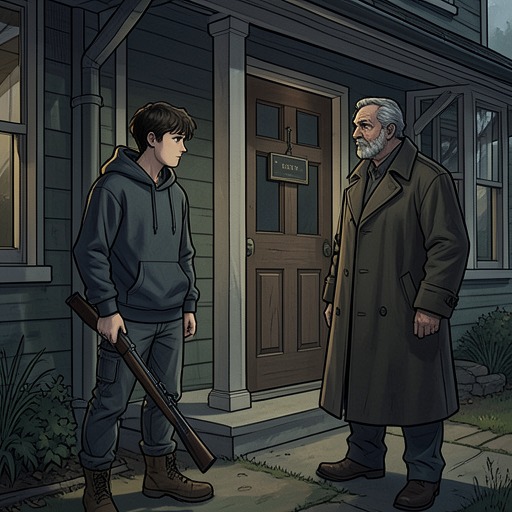
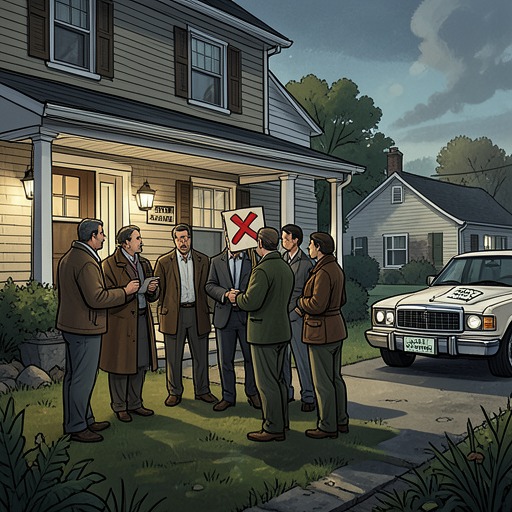
When the man in the white shirt arrives with three young men in nurse uniforms to remove Rune, Anita stands in the doorway and refuses to let him pass. She argues that handing someone over when care becomes difficult would not be an act of love. Her resistance is physical in the simple sense that she holds her place on the threshold, but its force comes from the claim she makes on behalf of their marriage. The scene sets the authority of an official decision against Anita’s knowledge of the person she has cared for and her refusal to understand that care as disposable.
Community, Continuity, and Significance
Anita’s relationships extend beyond the immediate dispute over Rune’s care. Years earlier, when a young woman and her nine-year-old son faced violence in their home, Anita and Rune took the woman in for two weeks while she waited to return. Ove and Rune later went to the bank, and Sonja and Anita made financial help available to the woman as either a gift or a loan, leaving the choice to her. The family remained in the house, and the boy was Jimmy. This history establishes Anita as part of a network of neighborly protection that acts through shelter, money, and sustained presence rather than declarations alone.
That network continues into the next generation. Jimmy later marries Mirsad, and the couple adopt a little girl. Jimmy brings her to Anita and Rune’s house every afternoon at three for coffee. Rune does not recover; at times he is virtually unreachable for days. Yet the child’s arrival reliably brings a euphoric smile to his face. Anita’s home thus remains a place of repeated visits and connection even as Rune’s illness deepens. The scene does not erase the burden of caregiving; instead, it shows how family life and companionship can continue around a declining condition.
Anita’s narrative significance lies in the way her loyalty exposes what institutional categories cannot fully contain. Social Services assesses whether she can manage Rune’s care, while Anita insists that the decision is also about the bond between two people and what it means not to abandon one another. Her earlier friendship with Sonja, her role in helping another woman remain in her home, and her later welcome to Jimmy’s daughter all place her within a pattern of practical care. When Ove eventually responds to her plight, his action grows out of that history: Anita is not merely the neighbor who needs help, but one of the people whose long presence has made the street a community.